
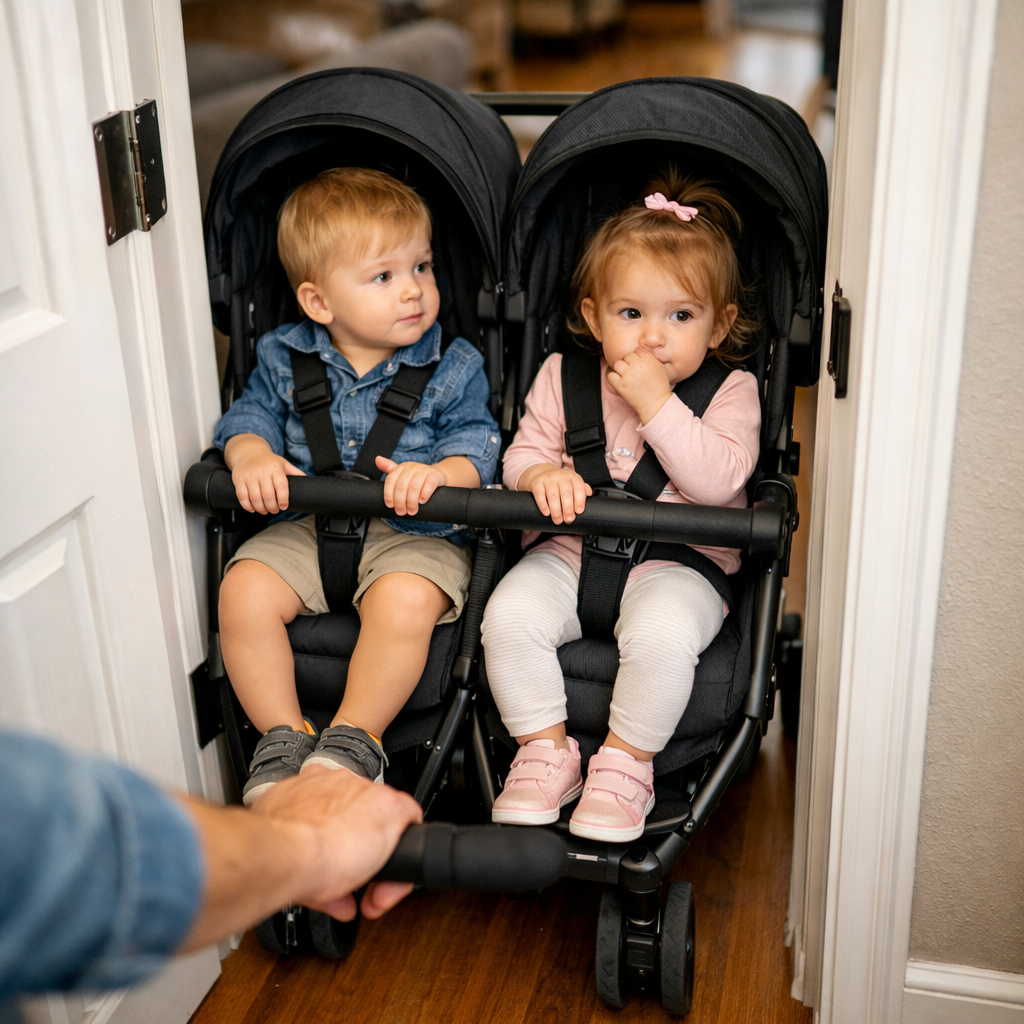
How to Choose a Compact Double Stroller for Narrow Doorways
Getting a compact double stroller through narrow doorways isn’t about chasing the lowest spec on a product page—it’s about matching your actual spaces to a stroller’s true footprint and how it handles. Start by measuring your tightest doors and hallways, then decide between side-by-side and tandem based on your routes. From there, prioritize maneuverability, suspension, and a repeatable fold you can do one-handed. Below, we walk you through the steps and share mom-tested picks that glide through tight thresholds without drama.
Start with your real doorway measurements
Marketing specs usually list frame width, but real fit depends on the stroller’s total footprint—outermost wheel hubs, rear axle shape, brake pedal, and even cup holders can add quiet inches beyond what you expect. Some models that “look” narrow on paper snag because those outer bits set the true widest point, not the frame itself (as narrow-doorway roundups note in practice).
Total footprint is the stroller’s maximum usable width and length in real life, including outermost wheel hubs, axles, and add-ons. It differs from the frame width shown in marketing and better predicts whether a stroller clears tight thresholds, trim, and door hardware without bumping, scraping, or twisting your steering angle.
How to measure for success:
- Measure your narrowest interior door (hinge-to-stop), plus your entry door including trim and any storm door.
- Measure elevator openings and hallway pinch points, including baseboards and handrails.
- Compare those numbers to a stroller’s widest point (wheels, hubs, and accessories).
- At A Day in Mollywood, we add 1–2 inches of buffer to any published width for hub/accessory clearance to avoid frustrating returns, a tip echoed in guides for small cars and tight spaces from Valco Baby’s experts (see their tight-spaces buying advice).
Decide on side-by-side or tandem for your routes
Quick comparison:
- Tandem (in-line): Slimmer for narrow aisles and very tight doors but longer overall; can be harder to pivot in cramped corners and elevator cars, a common tradeoff explained in Albee Baby’s double-stroller overview.
- Side-by-side: Seats kids next to each other, often with independent reclines and stable balance for turning. Many modern designs target 29 inches or less to pass standard single doors, a design goal highlighted in Baby Cubby’s buying guide.
When doors are especially tight, specialized setups like the YOYO Connect tandem add-on keep frame width minimal so two kids can still slip through truly narrow thresholds, as noted in narrow-doorway stroller roundups.
Decision guide (match your reality to a better bet):
- Doors under ~30 in, lots of grocery aisles: Narrow tandem or ultra-slim side-by-side.
- Frequent elevators and tight hallways: Short wheelbase side-by-side for easier pivots.
- Transit/ride-share often: Light tandem or modular add-on system that stays narrow.
- Siblings who pass snacks/play together: Side-by-side with independent reclines.
Prioritize maneuverability and suspension over specs alone
A narrow number on paper doesn’t help if the stroller fishtails at thresholds. Narrow-door friendliness is as much about total footprint and real-world behavior as it is about width. Look for swivel front wheels that lock when needed, predictable steering, and meaningful suspension that keeps a loaded stroller tracking straight over door lips and sidewalk seams.
Stroller suspension is the spring or shock-absorbing system that smooths bumps and keeps wheels planted. Effective suspension improves straight-line tracking over thresholds, reduces wobble at low speeds, and helps a loaded stroller turn predictably in tight indoor spaces, hallways, elevator entries, and curb cuts.
If you navigate mixed sidewalks, hybrid or air-style tires can upgrade ride quality; hybrid tires offer some of the cush of air with less maintenance, a benefit called out in Baby Cubby’s primer on double strollers.
Compare true width and folded footprint
Read spec sheets with a critical eye. Compare both open width (including wheel hubs and axles) and the folded footprint you’ll store in an apartment closet or car trunk. Many side-by-sides are intentionally kept at 29 inches or less to slide through standard single doors, while anything much wider than ~25 inches can start to feel clunky in packed aisles or tight pantry doorways. For a real-world narrow option, The Bump’s testing notes the Mountain Buggy Duet at about 24.4–25 inches wide—built specifically to clear standard doors—with air-filled tires, a handbrake, and a self-standing fold.
Spec sanity check before you buy:
- Widest point with wheels, hubs, and common accessories attached
- Folded standing height and depth (will it fit next to coats or the stroller nook?)
- Trunk fit with one seat removed if needed
- Hallway parking depth (measure from wall to doorknob you still need to clear)
Sample shortlist comparison (doorway-friendly focus):
- Mountain Buggy Duet: ~24.4–25 in wide; self-standing, one-hand fold; air tires; strong door clearance (noted by The Bump).
- Valco Baby Snap Duo Trend: ~29 in wide; light for a double; compact fold suited to small cars (discussed in Valco’s tight-spaces guidance).
- Zoe Twin+: ~29 in wide; very light; slim fold favored by travel testers.
- YOYO2 + YOYO Connect: ~17 in frame width (stays single-frame narrow); modular tandem for ultra-tight doors.
Test the fold, carry, and steering with weight on board
If possible, test in person:
- Push through an actual doorway or store threshold and note whether it glides or catches.
- Practice the fold/unfold with one hand while holding a diaper bag or a toddler’s hand.
- Load both seats with weight (bags or a child) and steer through a 90-degree turn. A true narrow-door champ tracks straight across thresholds and pivots without wrestling.
Models frequently praised by testers for compact, repeatable folds include Joolz Aer+ (a genuinely one-handed fold) and UPPAbaby MINU V3, which behaves predictably in hallways—great benchmarks for what “easy” should feel like even if you’re shopping doubles. For carryability up stairs, many urban-friendly singles target sub-20 lb and travel doubles aim under ~30 lb to reduce strain, a target echoed in tight-space buying guidance.
Check safety, comfort, and daily-living details
Width is only part of the story. Confirm five-point harnesses, reliable brakes, near-flat reclines for naps, and canopies with real coverage. The Bugaboo Butterfly, while a single, is a helpful benchmark for how a compact frame can still deliver smart canopy and basket access—proof that small doesn’t have to mean compromised usability in daily life. Adjustable handlebars improve control in tight passages, and even weight distribution helps a double corner naturally when kids are different ages. Add parent organizers, cup holders, and weather shields to reduce daily friction—but make sure add-ons don’t push the stroller beyond your doorway clearance, a point travel stroller guides flag frequently.
Make your shortlist for narrow doors
The winning formula is simple: match your measured doorways to a stroller’s total footprint, then confirm the handling—fold, carry, and steering—before you commit. In tight spaces, testers often weight what matters most this way: Weight & Folded Size (40%), Ease of Use (30%), Maneuverability (20%), and Quality (10%), according to BabyGearLab’s double-travel stroller methodology.
Suggested picks by use case below include key specs that matter for narrow doors.
Everyday urban and apartment living
- Mountain Buggy Duet (side-by-side): ~24.4–25 in wide; air-filled tires; handbrake; one-hand, self-standing fold; about 37 lb in testing. Built to clear standard doors while staying stable on city sidewalks (as highlighted by The Bump’s reviewers).
- YOYO2 + YOYO Connect (modular tandem): Keeps frame width minimal for truly tight doors; great for elevators and older buildings with skinny thresholds; easy to stash by the door thanks to compact pieces.
- Valco Baby Snap Duo Trend (side-by-side): ~29 in wide; lighter than many doubles; compact fold that suits small apartments and trunks.
Quick table: width and folded footprint notes
| Model | Open width | Folded footprint (notes) |
|---|---|---|
| Mountain Buggy Duet | ~24.4–25 in | Self-standing; relatively short depth for closet nooks |
| YOYO2 + YOYO Connect | ~17 in frame width | Two compact pieces; easy to carry up stairs |
| Valco Baby Snap Duo Trend | ~29 in | Flat, trunk-friendly fold; light for a double |
Travel and trunk space
- Zoe Twin+ (side-by-side): ~29 in wide; very lightweight; slim, flat fold that slides into small trunks; easy push for theme parks and museums.
- Baby Jogger City Tour 2 Double (side-by-side): Among the narrower doubles; compact fold that stores well in car trunks while staying maneuverable in crowded tourist spots.
- Snap-and-go frame + infant seat: For the early months, a snap-and-go frame keeps everything compact for airports and ride-shares, a strategy many travel parents use to minimize bulk.
Mixed terrain and older siblings
- Mountain Buggy Duet: Narrow at the door, capable on parks and uneven sidewalks thanks to air tires and sturdy suspension; handbrake helps on slopes.
- Valco Baby Snap Duo Trend + hybrid tires: Hybrid or puncture-resistant tires and real suspension smooth curb hops and playground edges without giving up door clearance.
- Balance your load: Place the heavier, older sibling on the side that gives you the most natural cornering on your typical route; adjust the handlebar to keep wrists neutral on inclines.
A Day in Mollywood’s take
We’ve raised kids in tight spaces—and hauled strollers up old apartment stairs. What reduces the mental load isn’t a flashy spec sheet; it’s a stroller that truly fits your doors, folds one-handed without a wrestling match, and steers calmly with two kiddos aboard. Bring a tape measure to the store, compare your narrowest opening to the stroller’s widest points (wheels, hubs, and add-ons), and practice the fold with a bag on your shoulder. If you’re also juggling comfort for growing kids, our guide to tall-toddler stroller comfort shares setup tweaks that prevent slouching and dangling legs. For family trips, our weekend packing checklist keeps the trunk tidy so your folded double actually fits next to luggage.
Frequently asked questions
What stroller width will fit standard single doors?
Aim for under 30 inches, with 25–29 inches often ideal for tight doors and aisles. At A Day in Mollywood, we recommend measuring the wheel hubs—not just the frame—before you buy.
Can a side-by-side double really clear narrow doorways?
Yes—many modern side-by-sides are designed around door clearance. We routinely see 25–29 inch models pass standard single doors when you’ve measured your openings correctly.
Is a tandem stroller always better for tight spaces?
Not always. Consider whether you’ll have room to pivot in elevators and halls, not just squeeze through the doorway.
How much does fold type matter for apartments and cars?
A lot. We favor one-hand, self-standing, compact folds because they simplify doorway-to-elevator moves and save trunk and closet space.
What features help most with curb hops and thresholds?
Quality suspension, swivel front wheels, and grippy brakes keep the stroller tracking straight. We also prioritize adjustable handlebars and balanced loading for control over bumps.