
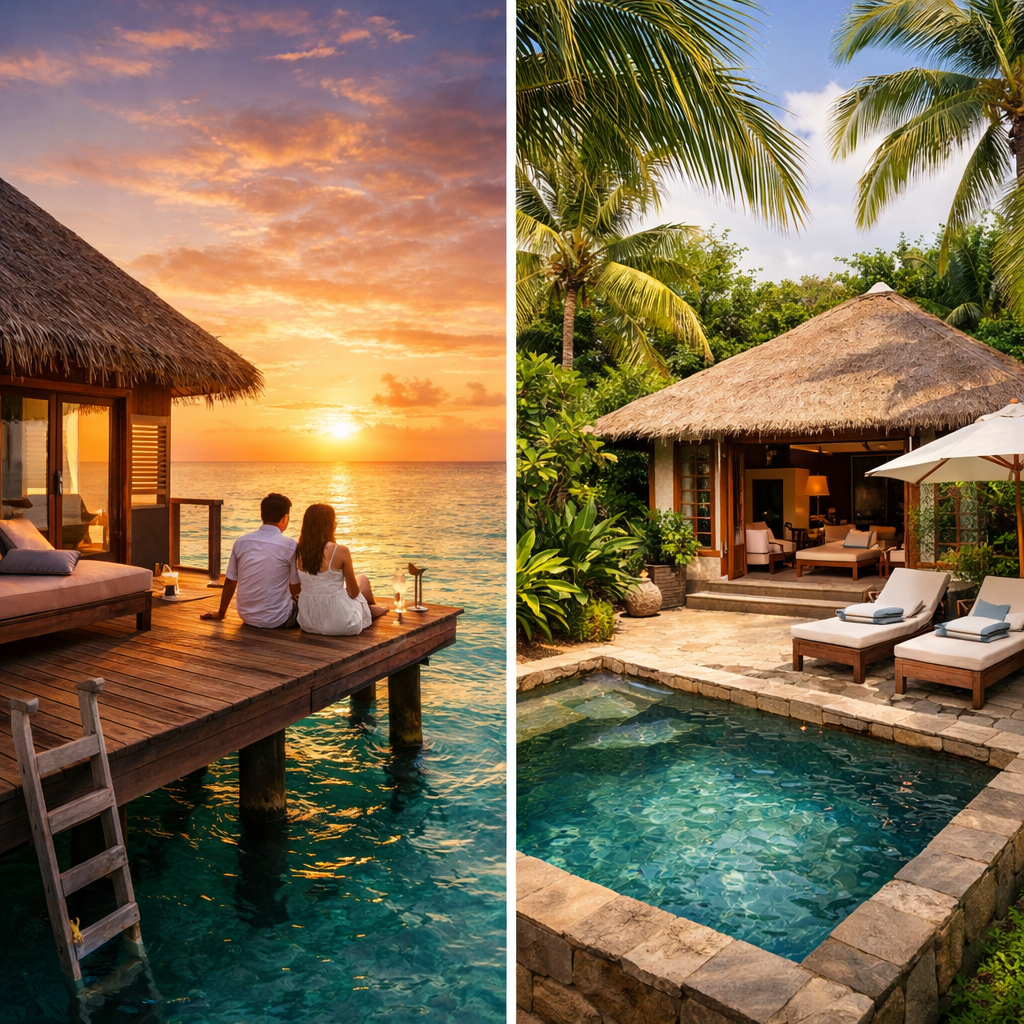
Overwater Bungalows vs Villas: Choosing Your Luxury Honeymoon Haven
A luxury honeymoon should feel effortless, romantic, and perfectly “you.” The short answer: choose an overwater bungalow if you crave ocean immersion and seclusion; choose a beach or land villa if you want more space, convenience, and value. Many couples get the best of both with a smart split stay—3–4 nights over the water for the “wow,” then several nights on land to enjoy amenities and stretch the budget. Below, I’ll help you compare romance, space, ocean access, convenience, cost, safety, sustainability, photos, timing, destinations, and who each option suits—so you can book confidently.
What this comparison covers
An overwater bungalow (also called an overwater or ocean villa) is a standalone suite built on pillars above a lagoon or sea, connected to shore by a boardwalk, typically with a private deck and often glass-floor panels for viewing marine life—designed for ocean immersion and seclusion, not quick hub access (see this practical overview from Visual Itineraries for layouts and distance trade-offs) (Overwater Bungalows primer). In contrast, a beach/land villa sits on shore, usually nearer to restaurants, spa, and activities. This A Day in Mollywood guide compares romance/privacy, space/comfort, ocean access, convenience, cost/value, safety/mobility/weather, sustainability, photo potential, booking timing, split-stay strategy, top honeymoon destinations, and couple-type recommendations. For inspiration on premium sizes and features (like glass floors and butler service), browse curated water villas on Dream Overwater (feature-rich water villas).
How to choose based on your honeymoon priorities
If your top priority is ocean immersion and privacy—and you don’t mind long jetty walks—choose an overwater bungalow. If you value bigger indoor/outdoor space, easier resort access, and a friendlier travel budget, book a beach or land villa; Islandii’s Maldives comparison highlights overwater privacy and direct lagoon access versus land-based convenience and mobility ease (overwater vs. beach villa reality check).
Try a quick scoring exercise (1–5 for each, higher = more important):
| Priority | Your score (1–5) | Why it matters | Overwater shines when… | Villa shines when… |
|---|---|---|---|---|
| Romance/Privacy | Seclusion vs. resort buzz | You want horizon views and minimal neighbors | You prefer cozy gardens or private beach | |
| Space/Comfort | Daily living flow, storage, bathrooms | You’re view-first, okay with compact interiors | You want larger bathrooms/closets | |
| Ocean Access | Spontaneous swims/snorkel | You’ll swim from your deck daily | You prefer shore swims and calmer entries | |
| Convenience | Walks to dining/spa/activities | You’re OK with buggies/long jetties | You want quick walks everywhere | |
| Budget | Nights and experiences you can add | You’ll splurge a few nights for “wow” | You want more nights/value flexibility |
A Day in Mollywood tip: Consider a split stay—3–4 nights overwater, then move to a land villa—for the iconic photos and privacy plus better value and convenience. This hybrid plan is widely recommended for balancing romance and cost (balanced split-stay guidance; Maldives trade-offs).
Overwater bungalows at a glance
- Signature perks: step-to-lagoon ladders, panoramic sea views, steady breezes that can reduce bugs, and often glass-floor panels; many add private pools and butler service for a true luxury honeymoon (Maldives pros/cons; feature examples).
- Price benchmarks: entry-level overwater rates commonly around $600–$900 per night, with top-tier suites $2,500+ per night; there are rare budget outliers from about $170 per night in select regions (price realities; affordable exceptions).
- Context: expect higher cost and potential distance from resort hubs—some outer bungalows can sit up to roughly 900 yards down a jetty (distance trade-offs explained).
Beach and land villas at a glance
Beach and land villas often provide larger indoor/outdoor footprints, closer proximity to dining and spa, and the widest price range—from budget-friendly around $150 per night to ultra-luxury over $5,000+, giving more flexibility to match your travel budget and honeymoon planning priorities (full-spectrum pricing). The vibe is less novel than “floating” suites and slightly buzzier, but unbeatable for quick access to activities and excursions. They’re ideal if you picture easy walks to breakfast, oversized bathrooms and closets, and leafy courtyards or plunge pools over open-water decks.
Romance and privacy
Overwater bungalows are engineered for seclusion: endless water views, direct deck-to-sea dips, and those “wow” sunrise shots—factors many travelers rate as more intimate than clustered land layouts (privacy and wow factor; Maldives privacy notes). Beach and land villas deliver a cozy, grounded feel with private paths and beach access, though occasional foot traffic can occur depending on layout.
Romance boosters to compare:
- Overwater: sunset decks, outdoor soaking tubs, overwater hammocks.
- Villas: beachfront firepits, large shaded terraces, landscaped gardens (Caribbean villa inspiration).
Space and comfort
If you want room to spread out, beach/land villas usually win on square footage and storage; overwater suites emphasize views and decks, sometimes with tighter interiors. Premium water villas can still be spacious—many list ranges around 1,205 to nearly 2,906 square feet in top categories (size examples across properties). Always review floor plans and sun exposure; lagoon villas with rooftop plunge pools around 2,385 square feet can provide both shade and cooling options in hot climates (rooftop plunge inspirations).
What to compare at a glance:
- Sleeping area: king bed footprint and bedside storage
- Bathroom size: double vanities, soaking tub, indoor/outdoor showers
- Wardrobe/storage: closets, luggage space, vanity seating
- Indoor lounge: sofa, dining nook, airflow (fans/AC)
- Outdoor deck/pool: plunge size, steps to water or garden
- Shade: covered terrace vs. full-sun deck
Access to the ocean and activities
Overwater living means spontaneous swims—step from your deck into clear water, often with included snorkel gear or even canoe breakfasts at romantic resorts (direct-water perks; experience-forward stays). Do note that some Caribbean-style options sit above manmade lagoons and reef quality varies by location, which affects snorkeling right off your deck (Caribbean variations and reef notes). Villas on land shorten your walk to fitness classes, spa, adult-only pools, and restaurants—ideal if your honeymoon includes lots of activities or off-property excursions.
Convenience and resort access
Expect a trade-off with overwater suites: longer walks or buggy rides to restaurants and spa; some outer bungalows are positioned hundreds of yards down the jetty (Maldives layout trade-offs; distance overview). On the plus side, the near-constant sea breeze over the water can mean fewer bugs and lower perceived humidity—comfort many honeymooners appreciate (comfort benefits of sea breezes).
Convenience hacks:
- Request buggy pick-ups for dinner or spa.
- Book restaurants nearest your jetty on late nights.
- Order in-villa breakfast or room service on early excursion days.
Cost and value
Set expectations early: overwater entry categories commonly price around $600–$900 per night, while luxury suites can top $2,500+. Traditional villas span roughly $150 to $5,000+ depending on resort and season (price ranges in context). Rare budget outliers for overwater experiences can dip to about $170 per night in specific regions and seasons (affordable outliers documented). Value-savvy moves: do a split stay, target shoulder season, consider breakfast-inclusive rates (some Caribbean properties advertise compelling breakfast-included deals in the high-$500s), and prioritize memorable experiences over the highest room tier (Caribbean rate examples and inclusions).
Safety, mobility, and weather considerations
Overwater settings can feel ultra-secure, but standard precautions still apply. Fodor’s notes occasional theft incidents by water access—use in-room safes and lock doors; it’s also easy to lock yourself out when doors open toward the deck, so carry a key or card (overwater safety know-before-you-go). Mobility-wise, long jetties and stairs to water ladders can be challenging; land villas closer to amenities are kinder for sensitive knees or accessibility needs (mobility trade-offs). Weather-wise, breezes over the water aid comfort, while storms or swells may add noise or affect docks and ladders (weather comfort notes).
Sustainability and impact
Marine park resort integration refers to properties built and operated near protected waters with measures to minimize environmental harm while allowing guest access to marine habitats. Many overwater properties in the Caribbean sit near protected areas or manmade lagoons, and some border marine parks with strong house-reef snorkeling from private beaches; always review a resort’s sustainability page before booking (Caribbean environmental context). Eco tips: pack reef-safe sunscreen, respect wildlife distances, avoid stepping on coral, and consider beach/land villas at eco-certified resorts if reducing overwater impact is a priority.
Photo moments and memory-making
Overwater suites deliver instant “wow”: glass floors, ladder-to-lagoon dips, and sunrise coffee framed by endless blue—photography gold for a luxury honeymoon (privacy-and-view magic; glass-floor inspirations). At night, under-floor lights sometimes attract fish for ethereal shots; prefer quiet? You can usually switch the lights off (nighttime ambiance tips).
Mini shot list:
- Floating breakfast or deck picnic
- Hammock over water or plunge pool toast
- Golden-hour beach walk and “just married” footprints
- Starry-sky silhouette on the jetty
When to book and how long to stay
For peak-season honeymoons, aim to book 6–9 months ahead; for shoulder season, 3–6 months often works. Overwater categories have limited inventory, so reserve those first. A popular cadence: 3–4 nights overwater to soak it in, then 3–7 nights in a beach/land villa for variety, convenience, and budget balance—watch for included perks like snorkel gear or sunset cruises that stretch value (planning cadence and inclusions).
The split-stay strategy Molly loves
Here’s the down-to-earth plan I recommend: start with 3–4 nights in an overwater bungalow for that unforgettable arrival, then move to a beach or land villa to enjoy easier dining, spa time, and local culture—while spending less per night. It’s my signature A Day in Mollywood approach for honeymoons that balance “wow” with real-world value. This aligns with Maldives-focused advice that weighs privacy against convenience (Maldives stay-mix perspective).
Easy steps:
- Book overwater first, villa second; confirm seamless transfers.
- Pack light for jetty walks; use soft-sided luggage.
- Schedule big excursions and spa days during the villa portion.
- Plan room service or a private dinner your first overwater night; snag sunrise photos before checkout day.
For more practical travel tips, browse our Travel archives on A Day in Mollywood (planning inspiration).
Destination considerations and popular regions
Overwater bungalows are most common in the Maldives, French Polynesia (Bora Bora), Fiji, and parts of Asia; you’ll also find Caribbean options, sometimes at more approachable rates and with distinct design twists (affordable Caribbean outlook; Caribbean overwater round-up). Variations include manmade lagoons and resorts bordering marine parks, as well as private-island settings for extra exclusivity (Caribbean layouts and settings; inspiration picks).
Examples to consider:
- Iconic overwater: Maldives for sheer variety and perks; Bora Bora for legendary lagoon views.
- Hybrid luxury: large lagoon villas with rooftop plunge pools (~2,385 sq ft) for shade and daytime lounging (rooftop plunge inspirations).
Final recommendation by couple type
- Romance-first, ocean-obsessed, light packers: Overwater bungalow—privacy, deck swims, and sea breeze comfort.
- Comfort seekers, foodies, spa lovers, mobility-aware: Beach/land villa—more space, easy access, and better value flexibility.
- Budget-balancers and memory-makers: Split stay—first half overwater for the “wow,” second half villa for convenience and savings.
Choose based on your daily rhythm: Do you picture sunrise swims and stargazing on the deck, leisurely brunch and spa time, or a little of both?
Frequently asked questions
Which is more romantic for a honeymoon: an overwater bungalow or a villa?
Overwater bungalows usually feel more romantic thanks to deck-to-lagoon swims, sweeping ocean views, and extra privacy. If you prefer convenience with a cozy, grounded vibe, A Day in Mollywood often points couples to beach or land villas with bigger spaces and gardens.
How much more do overwater bungalows typically cost?
Expect a premium: on A Day in Mollywood we routinely see entry overwater rates around $600–$900 per night with luxury suites $2,500+; traditional villas span roughly $150 to $5,000+ by resort and season.
Are overwater bungalows safe and practical for all couples?
They’re wonderful for confident swimmers and couples comfortable with jetty walks and water ladders. If mobility or quick access matter, A Day in Mollywood generally recommends a beach or land villa instead.
Is a split stay worth it for budget and experience?
Yes. On A Day in Mollywood, our go-to plan is 3–4 nights overwater for the “wow,” then a beach or land villa to enjoy amenities and save.
What should we pack for an overwater or villa honeymoon?
Pack reef-safe sunscreen, water shoes, a light sweater for breezy nights, and a dry bag. I also suggest a compact tripod for deck photos and any snorkel gear you love—A Day in Mollywood readers appreciate the reliable fit.