
Travel Strollers vs Baby Carriers: Which Works Better for You?
Travel with kids is a game of tradeoffs. Here’s the truth: there isn’t one best baby gear for travel and mobility—strollers and carriers shine in different scenarios. If you’re navigating airports or tight metros, a carrier often wins. If you need naps on the go and room for snacks, a travel stroller can be a sanity-saver. Below, I break down what to use when, plus how to choose for your child’s age, your itinerary, and your budget.
Key definitions up front:
- Travel stroller: A lightweight, compact stroller built for quick folds and easy maneuvering; most weigh about 10–17 lb and pack smaller than full-size models, according to BabyGearLab’s travel stroller tests.
- Travel system: A stroller paired with an infant car seat that clicks in and out without unbuckling—ideal for car-to-stroller transfers, as outlined by Consumer Reports.
- Soft-structured carrier (SSC): A padded, buckled baby carrier designed for ergonomic hip and spine positioning from newborn (often with an insert) through toddlerhood.
What you’ll learn:
- Airport ease and moving through crowds
- Naps and long-walk comfort
- Storage and hauling gear
- Age and stage fit
- Terrain performance
- Price and long-term value
How to choose for your family
Start with this simple framework:
- Where you’re going and how you’ll move: airports and public transit vs. car-heavy trips.
- Your child’s age and nap needs: newborn, older baby, or toddler.
- Your carry capacity: how much gear you realistically want to schlep.
A practical rule of thumb: carriers excel in crowds, stairs, and tight spaces where hands-free movement matters, and they pack down small for day bags, as noted by Gaia Baby’s guide to travel with carriers. Strollers win for solid nap support and for hauling snacks, jackets, and a diaper bag.
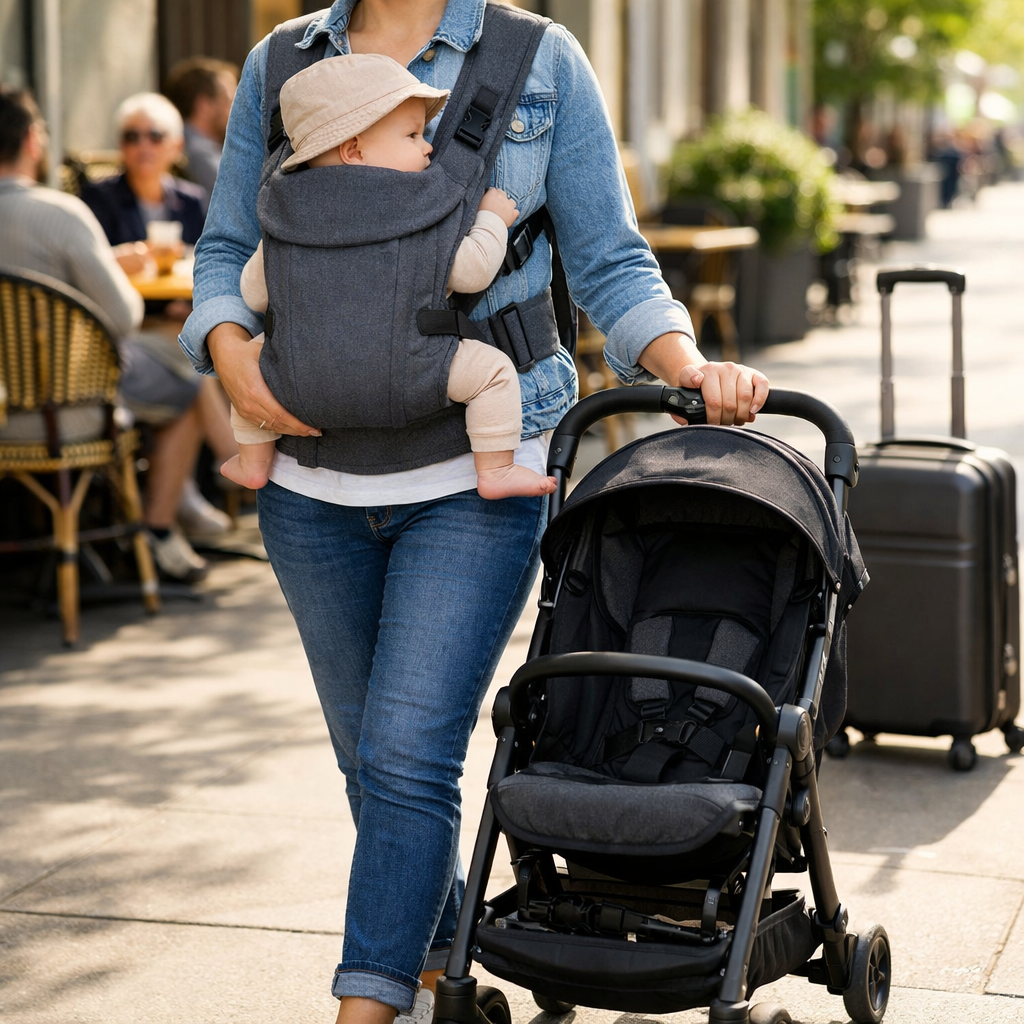
For most families, a hybrid is the sweet spot: bring a compact stroller for travel and long days, plus an airport-friendly baby carrier for lines, transfers, and quick comfort snuggles. Many parents shift between both as their baby grows and their plans change over the day, a pattern echoed by real-world comparisons from Marcela Limón. It’s the same practical approach I recommend on A Day in Mollywood.
Key decision criteria
When you evaluate gear for trips, compare:
- Portability: total weight, fold size, and how fast it collapses.
- Comfort (baby and caregiver): ergonomic support, breathability, adjustability, and how it feels after an hour of use.
- Storage: under-seat basket vs. wearing a backpack or crossbody.
- Age fit: newborn-safe recline or inserts; toddler support.
- Terrain handling: smooth sidewalks vs. cobblestones or parks.
- Nap support: recline, suspension, and shade vs. contact naps.
- Airline compatibility: carry-on potential or easy gate-check.
- Price and value: durability, warranty, and resale potential.
Quick definition—one-hand fold: A stroller mechanism that lets you collapse and secure the stroller with one hand while you hold a baby or documents. It’s a top filter for travel shopping, and Fathercraft highlights it as a must-have for fast transitions.
Portability and moving through crowds
Carriers streamline stairs, buses, and security lines while keeping both hands free for IDs and boarding passes. Wraps and SSCs also pack tiny into a carry-on or day bag, making them ideal for airport sprints and tight subway transfers, as Gaia Baby explains.
Travel strollers are engineered for compact size and quick folding, but they still take space—most weigh about 10–17 lb and need a spot in overhead bins or a gate-check tag. BabyGearLab’s travel stroller testing notes that the best models balance maneuverability and fold quality without adding bulk.
Airline handling varies. Some airlines allow a compact stroller onboard if it meets folded size limits; otherwise, most let you gate-check for free. Policies change, so always check your airline’s current stroller rules, a reminder echoed by Fathercraft’s travel stroller guide.
Secondary keywords woven in: compact stroller for travel, airport-friendly baby carrier.
Comfort for baby and caregiver
A well-fitting ergonomic carrier supports healthy hip and spine positioning and fosters soothing chest-to-chest contact; that closeness can help regulate a young baby’s temperature and heart rate during travel, as outlined in SSC guidance and babywearing resources from BabyMaxi and Gaia Baby. For caregivers, padded shoulder straps and a supportive waistband are essential, especially in warm weather.
That said, wearing a heavy toddler all day can strain backs. A stroller offloads the weight, gives you breathable shade, recline, and suspension for smoother naps, and often keeps everyone more comfortable during multi-hour sightseeing, a balance many parents describe in practice and that Marcela Limón’s comparison underscores.
Storage and hauling gear
Most travel strollers include an under-seat basket that swallows diapers, snacks, water bottles, and jackets—hugely helpful if you’re managing siblings or souvenirs. Families of multiples can also consider compact doubles or stroller boards for older kids. Carriers don’t include storage, so pair them with a backpack diaper bag or a slim crossbody and commit to packing light.
Age and stage considerations
For infants under 6 months, prioritize a flat, newborn-safe recline, a bassinet, or a travel system for safe positioning and quick car-to-stroller transfers, consistent with Consumer Reports’ guidance. Carriers are especially useful in the early months for soothing and bonding; as babies grow, most families end up using both a carrier and stroller depending on the day’s plan.
For toddlers, stamina and nap needs make a stroller compelling, especially for long days. Still, a compact toddler carrier is gold for quick “up/down” moments or crowded transit—some models weigh roughly 300 g and fold in seconds, as WildRide notes.
Terrain, naps, and long-day stamina
Expect limitations off pavement: most travel strollers aren’t built for trails or cobblestones and can feel bouncy on rough surfaces. Fathercraft calls out this tradeoff in their travel stroller advice. When marathon sightseeing is on the agenda, strollers generally support longer, higher-quality naps after the newborn phase. For metro- and stair-heavy routes, carriers maintain an edge—no elevator hunts, hands free for luggage, and quick boarding, as Gaia Baby highlights.
Price and value over time
Set a realistic budget and decide where you want the long-term value. A well-built travel stroller can last multiple kids and resell well; carriers may change with stages (newborn wraps to SSC to toddler carrier), but can also be used across children. Independent testing from Consumer Reports and BabyGearLab compares durability, maneuverability, and weight—use those lab insights to find the best mix of quality and price. If you’re unsure what you’ll truly use, it’s reasonable to buy your full-size stroller after baby arrives when your routines are clearer, a tip Consumer Reports often shares.
Secondary keywords: budget travel stroller, best value baby carrier.
Side-by-side comparison
| Factor | Travel stroller | Baby carrier |
|---|---|---|
| Portability | Folds compactly; typically 10–17 lb. Quick one-hand folds speed transitions (per major travel tests). | Folds tiny, fits in a day bag, and keeps hands free in crowds and on stairs. |
| Comfort (parent/baby) | Offloads weight; recline, shade, and suspension aid longer naps. | Ergonomic positioning and chest-to-chest soothing; may strain caregiver with heavier toddlers over time. |
| Storage | Under-seat basket for diapers, snacks, jackets, souvenirs. | No built-in storage; pair with a backpack or crossbody. |
| Age range | Newborn-ready with full recline, bassinet, or travel system; great through toddler years. | Newborn to toddler (with inserts and correct fit); toddler carriers extend “quick up” usability. |
| Naps | Strong choice for consistent, longer on-the-go naps. | Excellent for contact naps in early months; less ideal as baby gets heavy. |
| Terrain | Best on sidewalks and smooth paths; limited on cobblestones and trails. | Unaffected by terrain; ideal for stairs and crowded transit. |
| Airline handling | Often gate-checked; some ultra-compact models fit overhead if within size limits. | Packs into carry-on; wear through security and boarding. |
| Price/value | Wide range; durable models hold value and can be used across kids. | Multiple carrier types may be needed over time; still budget-friendly overall. |
When a travel system makes sense
A travel system pairs a stroller with a compatible infant car seat so you can click baby in and out without unbuckling—huge for winter, rideshares, and quick errands, as Consumer Reports explains. One well-known example is Doona, a car seat that converts to a stroller without separate adapters; it’s very convenient in the newborn stage but has a shorter lifespan than a dedicated stroller, as The Bump notes in its travel stroller coverage. Even with a travel system, I still pack a soft carrier for stairs and crowds on transit-heavy trips.
Real-life travel scenarios and picks
- Airport + layovers: Wear the carrier through security and boarding for hands-free speed; park a compact stroller at the gate for naps. Most airlines allow gate-check when overhead size limits don’t work, and carriers move fastest through crowds (Gaia Baby; Fathercraft). High performers for maneuverability and easy folds include Joolz Aer+ and UPPAbaby MINU V3 in BabyGearLab’s tests.
- City sightseeing with stairs/metro: Make the carrier your primary; bring a stroller only if you expect a long afternoon nap.
- Theme park long days: Choose a travel stroller for storage and recline; stash a carrier for lines and late-afternoon meltdowns.
- Cobblestones/old towns: Expect some bounce and wheel chatter with a stroller; keep the carrier handy for rough stretches.
- Toddler who wants to walk: A compact toddler carrier avoids pushing an empty stroller and pops out in seconds for tired legs; some weigh around 300 g (WildRide).
Recommendations by trip type
- Weekend city break: Soft-structured carrier for travel plus an ultralight, compact stroller for naps and storage.
- Road trip with infant: Travel system or bassinet-ready stroller for safe positioning; a carrier for rest-stop changes and soothing (per Consumer Reports guidance).
- Resort/vacation with long walking days: Travel stroller with decent basket and recline; carrier for lines and contact naps.
- Solo parent flying: Hands-free carrier for check-in and security; add the best stroller for travel with toddler if you need storage and predictable naps. A lightweight umbrella stroller can work in a pinch, but prioritize a modern compact with a one-hand fold.
Keywords included: best stroller for travel with toddler, lightweight umbrella stroller, soft-structured carrier for travel.
Packing and airline tips for smooth travel
- Check your airline’s stroller size rules; many allow compact models onboard if they fit overhead, or free gate-check if not.
- Pack your carrier in your personal item so it’s ready for boarding and tight connections; use the stroller at the gate for naps.
- Label everything, bring a rain cover, and practice the one-hand fold at home.
- Keep the stroller basket light and wear a backpack diaper bag to balance the load.
For more portable baby gear advice, explore our Portable Baby Gear hub on A Day in Mollywood.
Molly’s take as a mom of three
On a winter layover in Chicago with my youngest, the carrier shaved precious minutes off security—no folding, no juggling. By hour eight, though, everyone needed a reset, and the stroller’s recline and canopy turned a chaotic terminal into a nap zone while I refueled with a sandwich and a deep breath. That’s our family’s rhythm: switch tools as the day shifts. We aim for budget-conscious picks that lower stress, not raise it. Alternate babywearing and stroller time to give your body breaks and to support your child’s movement variety; many parents and pediatric experts caution against too much stroller time for motor development, a reminder echoed in real-world guides like Marcela Limón’s. Choose the option that protects your energy today—that’s the win.
Frequently asked questions
Are travel strollers allowed as carry-on or do they need to be gate-checked?
Many airlines allow compact strollers onboard if they meet size rules; otherwise, you can usually gate-check them for free—on A Day in Mollywood, we always recommend confirming your airline’s current policy before you pack.
Are carriers safe for newborns on trips and how long can I wear baby?
Yes—newborn-safe carriers that support ergonomic positioning are appropriate from birth with proper fit (we outline quick fit checkpoints on A Day in Mollywood). Most parents wear baby for 30–90 minutes at a time, taking breaks for feeds, diaper changes, and to rest their back.
What features matter most in a travel stroller?
Prioritize a one-hand fold, low weight, good maneuverability, and a decent basket; on A Day in Mollywood, we also look for a reclining seat and sunshade to help with on-the-go naps on long sightseeing days.
Do I need both a stroller and a carrier for travel?
Many families pack both to cover different needs—carrier for crowds and quick transitions, stroller for naps and hauling gear; if you’re packing minimal, choose the one that best matches your itinerary—that’s the approach we take on A Day in Mollywood.
What’s the best choice for airports and public transit?
A carrier is usually faster for security and navigating stairs or buses. On A Day in Mollywood, we pair it with a compact travel stroller if your child needs longer naps or you’re hauling extra bags.